Closing the loop and starting a new one: My experience at GDC 2026
Back at GDC after 9 years
This was my second time attending GDC, the first time was in 2017. I had but a couple of years in the industry and I was starting a new indie game studio called Spoonman Games. Now, 9 years later, with over 10 years in the belt, a failed indie studio experience, and a more mature vision of the industry I saw myself in a similar place all those years back: looking at what my next 10 years are going to be, a time for decisions.
GDC took part about a month ago from March 9-13 2026, on those five days I attended talks, meetings, showcases and networking party events. It was a great opportunity to connect with other developers, put into action my personal pitch and give away so many business cards.
On this entry we will go day by day and explore the talks and highlights of each day. This is a long post, as it serves as a personal archive and guide of what I saw and learned. So if you are interested only in a few things I recommend you to check these three talks:
- ‘SILENT HILL f’: The Challenges of Creating a Melee-Only Horror Game - Al Yang from Neobards Entertainment: I took a lot of notes on what drives combat design in this game and how they apply in a general context, a must read.
- WICKED PROBLEMS: Balancing Complex Systems - Eric Zimmerman from NYU Game Center: A workshop about game design, a lot of cool exercises and ways to tackle balancing and mechanics in a game, take a look if you are working on the design of your game!
- When East Meets Western: Art Direction of ‘Ghost of Yōtei’ - Joanna Wang from SuckerPunch Productions: Are you doing any art direction for your games? Joanna Wang laid down some amazing tips, frameworks and patterns they follow at SuckerPunch. A must read if you are into art as I am.
If you want to follow up on any of these talks feel free to leave a comment at the end or reach out on any of my socials, I would love to expand on everything said here, as it is very likely some of these talks will take months to be available on Youtube, and some will be locked behind the GDC Vault. I’m happy to share.
Index
- Monday
- UX Mobile Porting Challenges in ‘Prince of Persia: The Lost Crown’ Case Study - Alexis Denance from Ubisoft Da Nang
- Etudes and Actors: Owlcat’s Tooling for Highly Branched Narrative - Alexey Drobyshevsky from Owlcat Games
- ‘Clair Obscur: Expedition 33’: Delivering a Wide Scope of Features & Content When You Only Have Four Programmers - Tom Guillermin and Florian Torres from Sandfall Interactive
- GDC Encounters: Speed Networking Day 1
- Tuesday
- Designing Crush-Worthy Characters in ‘Love and Deepspace’ - Xianzi Feng from Infold Games (Papergames)
- Why Good Games Fail: The Startup Audit Every Studio Needs - Lucien Parsons from OpsCat
- What’s next for CoreCLR, Entities, unified transform, UDM, serialization, and more - Joe Valenzuela from Unity
- Steam Annual Update: The Latest on Steam in 2026
- Wednesday
- Thursday
- Friday
- Bottom Line
Monday
The start of the event was exciting as ever, had to make quite the run since my place was further away from the venue than expected, still I managed to make it just in time for the first talk.
UX Mobile Porting Challenges in ‘Prince of Persia: The Lost Crown’ Case Study - Alexis Denance from Ubisoft Da Nang
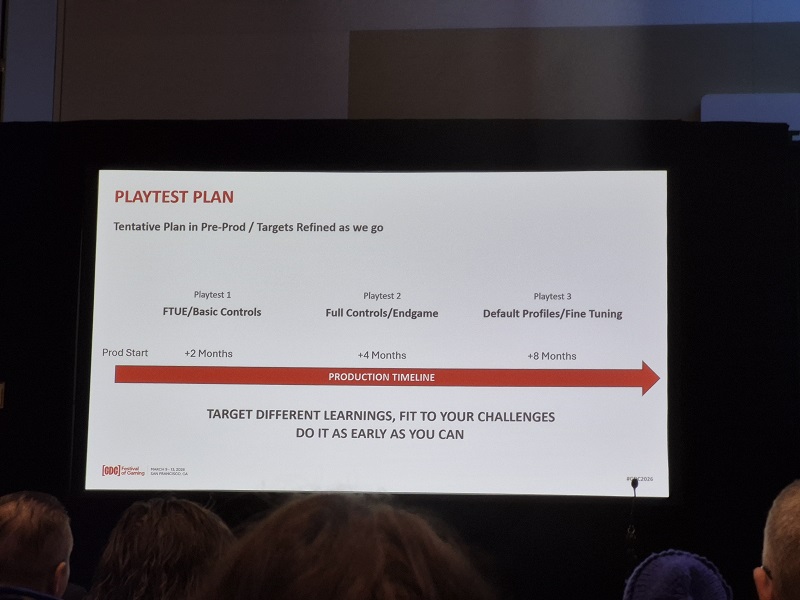
I am currently working on the mobile port of Sky Oceans: Wings for Hire, so I was pretty interested in this talk and seeing what challenges the Ubisoft team faced when porting the game. Here are some of the learnings:
- Keep joystick support and encourage to use it during start up for the original intended experience
- Use right side (or dominant side if adding lefty option) to display action buttons
- Identify if some actions are impossible to do with touch controls
- Offer resizing
- Use phone vibrations
- Analyze what other games do
- Use a virtual stick that is dynamic and can be pulled
- Make some actions automatic (Prince of Persia used as an example: use a potion on low health)
- Use visual cues when using audio cues
Their whole process spoke directly to what I am working on right now, implementing touch controls for characters and flying ships. The different options for configurations and direct implementation with virtual sticks and UI buttons make sense, and it is indeed the current industry standard, which makes me more confident on the approach I am currently following.
It is also interesting to see, as shown in the image above, that they took 8 months for the whole development of their port. Luckily it will be faster in our case since the game is more UI based and is not as action oriented.
Etudes and Actors: Owlcat’s Tooling for Highly Branched Narrative - Alexey Drobyshevsky from Owlcat Games
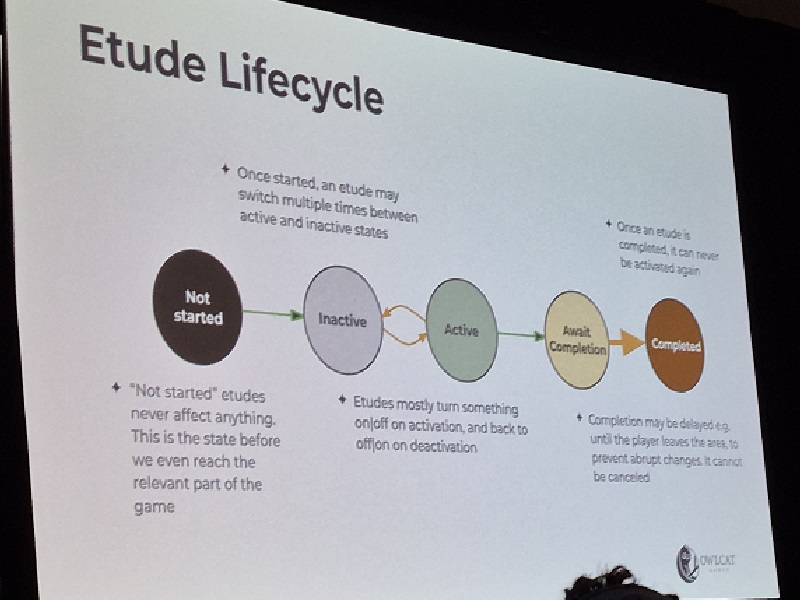
I love narrative and writing stories, even if it is something I do as a hobby and mostly for myself, if I have the chance to learn from professionals I will take it. They also showed the tooling they use to manage branching narratives, which was fantastic to see. Some of the learnings here were:
- Using flag solutions is too messy and does not scale
- Hierarchical Finite State Machines are better
- A state or Etude has
- Comments
- Parents
- Priority (and conflicts)
- Links
- Conditions
- Open/Close brackets
- When reading a state search the tree and activate by priority
Overall the most important teaching was how using FSMs makes the system more robust, but it is not a system you just go and use, it needs onboarding and a few months to understand everything you can do with it. Also Etudes is just a word they used to refer to these states, since Etudes didn’t seem to be a word used anywhere haha.
You can also notice how in my notes above an Etude is just a piece of data holding information about itself and its relationship with other Etudes in the FSM. They mentioned in the talk that one of the biggest issues they had with the flag solution used previously is that it was not able to handle all possible scenarios, and they would usually get bugs where some conditions softlocked the quest progression of the game. With Etudes this can be analyzed by reading the tree, and it becomes more obvious what is the chain of events that lead to a particular event or quest to trigger, and what consequences it has later.
This added complexity saves a lot of headaches down the road, and I think it is something good to consider in the creation of any system you are working on.
‘Clair Obscur: Expedition 33’: Delivering a Wide Scope of Features & Content When You Only Have Four Programmers - Tom Guillermin and Florian Torres from Sandfall Interactive
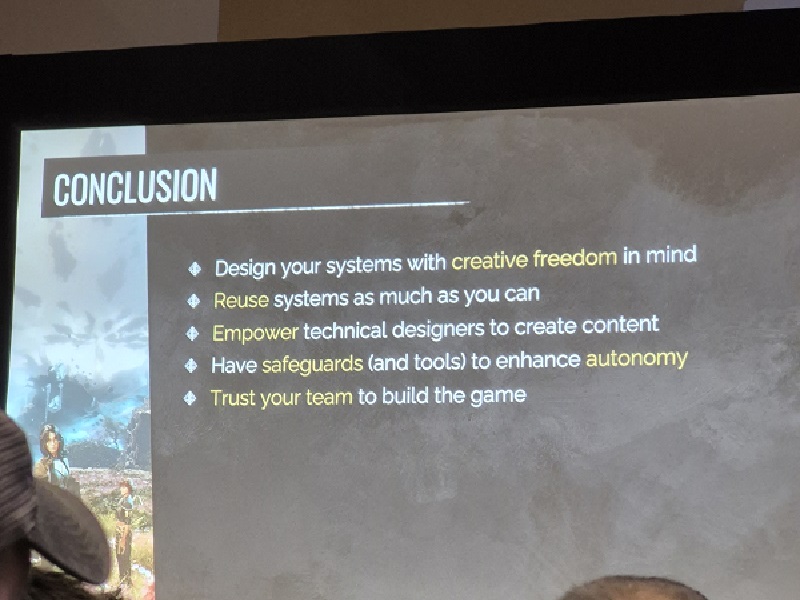
I don’t really use Unreal Engine, yet I was interested in any general wisdom they could share. And most of what they said was indeed pretty general. You have probably already heard that 95% of the game is done with Blueprints, a lot of outlets have covered that side already for weeks, and that was mentioned here in this talk. The point the team was trying to make when mentioning this was:
- Make the most of the Engine
- Use what the engine has to create a modern 3Cs (Character, Camera and Controller)
- Create tools for designers that can later make and adjust the game
- Create a clear workflow that uses most of the engine
- Do not modify or add extras to the Engine, so updating to new patched versions doesn’t become a pain
Overall the conclusions are as shown in the image above. Reusing and creating tools for the team is what took them far, allowing everyone to design, while only having four programmers on the team.
GDC Encounters: Speed Networking Day 1
This was a very fun activity, where you changed tables every 5 minutes to talk with random attendees. Met all kinds of people, other developers like me, and the game director of some of the latest Assassin’s Creed. All fun talks, it sure puts your pitching and time management to the test. I really recommend it as the stakes are low and you get to meet amazing people.
Tuesday
This day had a lot of interesting talks, and also a side event organized by Unity. I remember walking a lot this day, from place to place, and venue to venue. I am glad this happens during a good season in San Francisco and that the weather is nice.
Designing Crush-Worthy Characters in ‘Love and Deepspace’ - Xianzi Feng from Infold Games (Papergames)
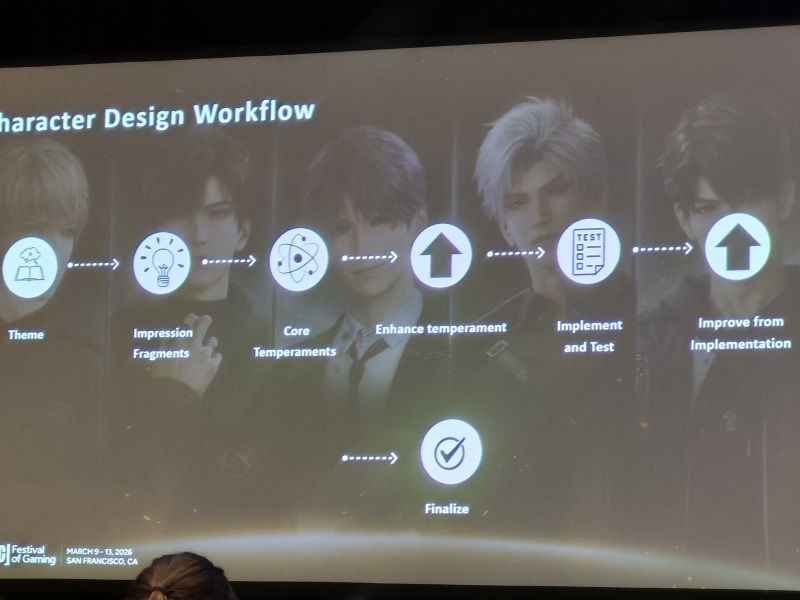
I took a lot of notes on this talk. Character design is one of those hobbies of mine, and one I’ve actually practiced in a professional context, sadly that game I worked on never released, and I’m not sure if I’m out of NDA. But I can say designing characters is a lot of fun, and this talk was incredibly insightful:
- Game Pillars: Romance, Training and Combat
- 6 Step workflow for love at first sight:
- Theme
- Impression Fragments
- Core Temperaments
- Enhance temperament
- Implement and test
- Improve from Implementation
- Move temperament into visuals & art
- Identify what is popular: Appeal to trends and expand with your ideas
- Love at First sight then becomes: Patterns + New
- Temperament is the mix between Psychological + visuals
- Create contrast: Familiar with something unexpected.
- Adding conflict in the design adds multidimensionality.
- To create a theme:
- Describe first, then identify keywords, do visuals elements of these and repeat.
- Create a style by temperament by character
- Repeat until satisfied.
It was eye opening to see their methodic approach to create something you usually imagine as just feelings. Everything can be constructed with the right process, and the one on display here is indeed very effective. It is important to note that this game’s target audience is mainly women, but even if you could argue it is easier for men, I would say then, why not use this too? The result would be magnificent.
Why Good Games Fail: The Startup Audit Every Studio Needs - Lucien Parsons from OpsCat
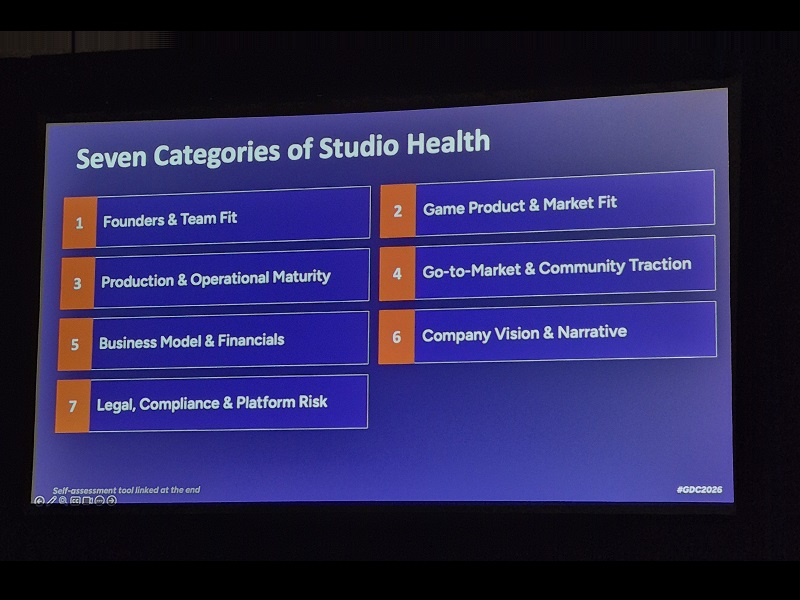
Nowadays I’m a freelancer or contractor working in different projects just for that one project and then moving on. However in my local Chilean industry I often work alongside small indie companies where I am the only senior, so helping with this stuff is gold material for me. Some of the more important points touched in the talk are:
- Anticipate your problems: be aware of your weaknesses.
- Make sure you know the quality of the things identified:
- A placeholder point is one that does not really provide any answers.
- A Proxy gets close, but is not something you can act really upon.
- A Signal is what you want, it gives you a real answer.
- Make sure there is someone who makes the final decisions
- You should be able to identify your audience in one sentence
- You need a hiring plan to find the people you need
- Where are your players? How do you reach them?
- How many months can you operate before running out of money?
- What is your business mission? What about a 3 year plan?
- Ensure you are operating under the law
- Somehow it is easier to pitch a game that is $1m dollars or less, or $10m dollars and more. The between range is somewhat in the red according to current trends.
Finally, Lucien shared the following form to make a studio Self-Assessment, go take it here: Studio Self-Assessment!
What’s next for CoreCLR, Entities, unified transform, UDM, serialization, and more - Joe Valenzuela from Unity
This was insightful and nice to see in person, however there was nothing new that you have not seen in the videos Unity itself has done on the topic on Youtube. The best part was to later go and talk with some of the Unity members. In particular I spoke with Rustum about 2D and their new pipeline to use 3D in the 2D lighting and physics pipeline, with a live demo I could play around. It was great to have such an opportunity and by far the best of this side event hosted by Unity.
Steam Annual Update: The Latest on Steam in 2026
This was a lot of cool information about Steam and the players on it. Here is a quick rundown of some of the numbers that caught my attention:
- There are 13.9m+ in-game concurrent users, with a peak of 42m+
- Steam is a private company
- Each month they identify best selling games and make three rankings: Gold, Silver and Bronze
- 5863 games have done over $100k+
- They are improving their localization and options for playtesting
The most shocking figure is the 5863 games selling more than $100k, in a platform where thousands of games are released daily, only a fraction really breaks over this limit. Usually the funds you ask for when making a game in my country are over $100k, which makes this a sour reality, since this means it is very likely you will never recoup. However this is also a good point to meditate on, see the scope of what you are doing and the reach you can have. Depending on the talent you have onboard you can consider this reality a good benchmark.
Wednesday
This day I had a lot of in person meetings and also the showcase opened, which was great to see some of the current games and technologies in development. I felt like it was smaller than I remembered, and there was also a lot of AI booths on all manner of subjects, which was a bit sad to see. Still the human touch remained and all those games took over.
When East Meets Western: Art Direction of ‘Ghost of Yōtei’ - Joanna Wang from SuckerPunch Productions
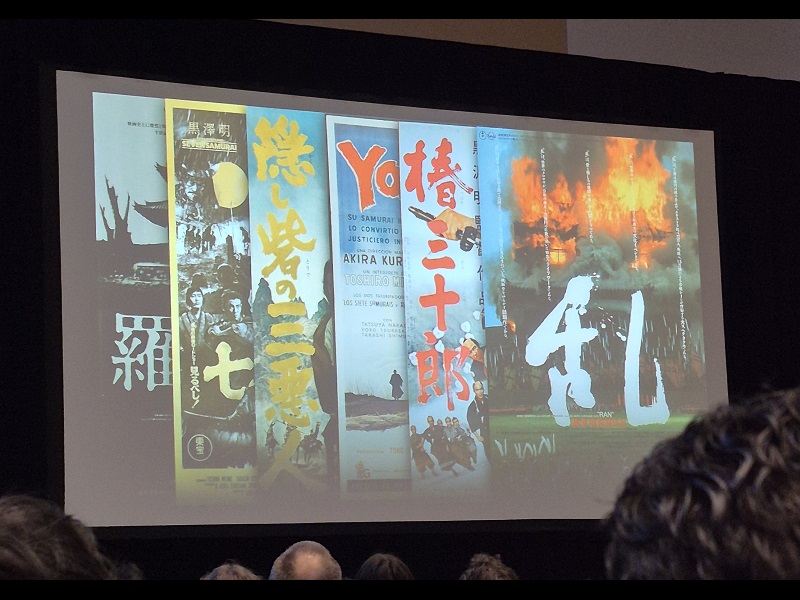
Art is one of those big passions I’ve always had, but I’ve never had the time to dedicate myself to being an artist. Yet I had to go to this talk, and it was amazing, I took a lot of notes on how to achieve a striking art direction in a game:
- The art of Yotei is inspired by old samurai films
- Use a four steps structure: Foundation, Focus, Identity and Destination
- Foundation: The living painting
- Color, Composition, Movement, Motion and Vibrant Colors
- Focus: Minimalism
- What really matters
- Identity: the Tone
- The feeling and message you want to show
- Destination: the Emotion
- Personal connection with the characters
- Do a map and find the identity of what you are looking for
- If possible have a real direct exposure to what you are doing, if it is a place like Yotei, travel there.
- Use a 60-30-10 framework: 60-main, 30-support, 10-accent
- This applies to colors and composition, and is a rough measure not a mathematical exact one.
- Denoise to have a clean and direct image. Have a clear color decision.
- Find contrast with colors and themes
After seeing this presentation I felt like jumping into this world, I’ve only seen the game through trailers, but now that I understand the visual identity they use I should really play it, but I would need a PS5 first, oh well one day.
‘SILENT HILL f’: The Challenges of Creating a Melee-Only Horror Game - Al Yang from Neobards Entertainment
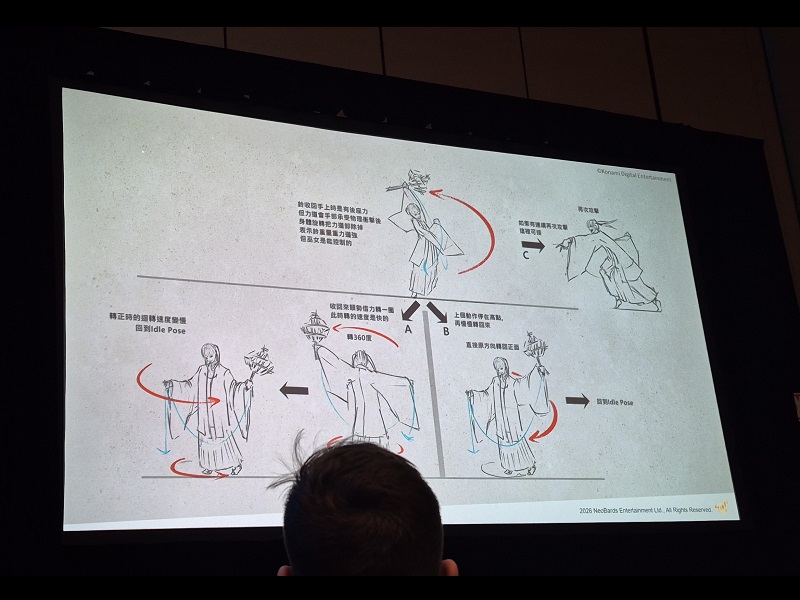
Combat design is one of the things I want to learn and master this year, one of my side projects is about creating a combat system for a top-down game, and knowing first hand what are the ways you can think about this kind of system was incredible, Al Yang gave such a good master class on it. Here are some of my notes:
- Doing something fresh & unique is a cyclical process, where today you take something that exists and try to do something unique, that later informs new things.
- A good distribution of development time is: 3/3/4/2, that is in months for prototype, vertical slice, production and QA.
- Identify Risks: Novel implementations, complicated features, costs, the use of your strengths.
- Manage Tension
- Is it Scary or tense? Horror is when you build up and then release
- Your resource in range is ammo, in melee is durability
- Tension can get frustrated, it is a grey line
- Familiarity reduces tension
- Check for learning rate metrics, have some expected progression
- Having player choice reduces tension
- Manage Information
- What to give/show or not
- In combat, damage reaction is super important
- Manage Resources
- Use scarcity
- Check your combat resource exchange rate
- If enemies always generate a negative resource outcome, then it discourages combat
- A heavy melee attack is like a headshot
- Have some active/passive resource management
- Manage Time
- Define a tempo/pacing rhythm
- Different weapons are different rhythms, like music
- Stamina regulates pacing through action rate, driving combat actions in an active way.
- When a player is focusing and looking to attack it is analogous to aiming in a shooter game, use it to slow down
- You have to release tension. The wait is bigger than the moment.
- Combat is a puzzle
- You need some kind of System Breaker/Master Key. This is something that solves a combat puzzle fast and easy. Like a powerful skill with a long cooldown, or an RPG in a shooter. Something with limited use, but helpful when you don’t want to completely deal with a situation.
As you can see I took a lot of notes, and a lot of pictures too. This master class was really insightful into the way you should be thinking when designing a combat system in general, with some added context regarding Silent Hill f itself, of which I am a huge fan.
Thursday
This was another heavy meeting day. One of the highlights was a Latin American meetup where I got to see some amazing people from all over the continent. I had never met people from all these countries. Chile is always down in a corner, and we have big natural limits with the rest, so we don’t go out often, so this was an incredible opportunity.
WICKED PROBLEMS: Balancing Complex Systems - Eric Zimmerman from NYU Game Center
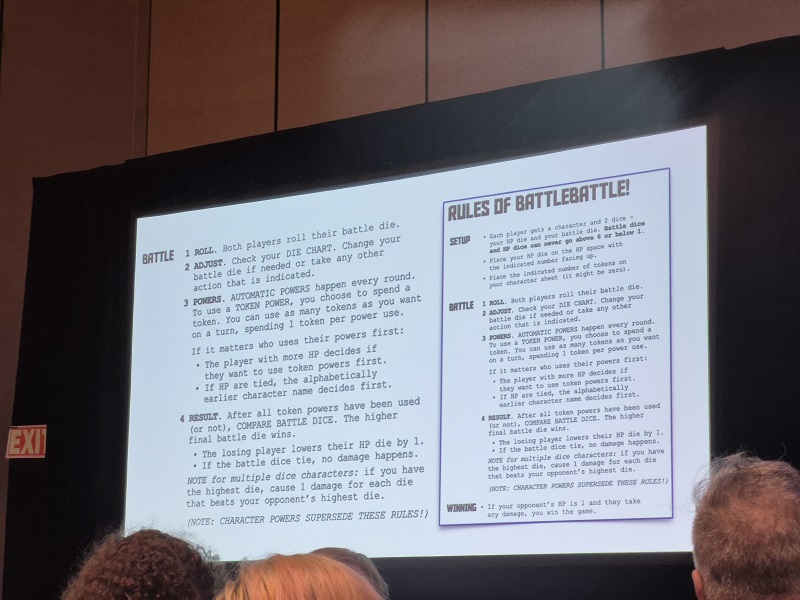
Initially I thought this was a talk, but actually it was a 4h workshop. I love game design, and having Eric Zimmerman teach me stuff first hand was a treat.
The first activity was one where everyone stood up, about 30-40 people in a big room. We walked around the room in a seemingly random way. Then you had to choose anyone from the room to be your Sun, just a mental note, and follow with your eyes. Later pick another person and make them your Moon. You don’t tell anyone who you picked, you just follow them in your mind. Then Eric says to try and do an eclipse, where you are Earth, and you want to align Moon and Sun. This had a very interesting effect where the whole group of people would move as a mass from one side of the room to the other as we all tried to follow each other. Then suddenly a stop was called. This was a good example of how simple rules could create complex behaviour that is hard to predict.
Then we played a simple shooting game, we were all seated at tables with a group of people, each table was its own group. We would use our hands to aim at other people, it was a rock-paper-scissors kind of game where depending on the gesture and who we aimed for, people got eliminated, the last one standing was the winner. After a few rounds some rules were changed, new ones added. It was interesting to see how a simple game can get messy and completely turn around by just moving a few pieces of it, some additions that seemed simple could have a lot of ramifications.
The last game was called Battle Battle!!, it had quite a few rules, most are shown in the image above. But in short, you make a pair with someone and take character sheets representing heroes. We had a vanilla one, which was used to balance the others, as we played with them we could add rules, and then return those heroes to the pool and grab new ones which could have some modifications from another pair. This was a pretty neat exercise on balancing and understanding the design of each hero. The Vanilla character serves as a yardstick to measure and balance the rest. However this still had some issues, as the Vanilla may not be the best yardstick for comparing all heroes, it could be bringing the whole cast down instead. The conversations around this were pretty interesting.
Eric added that Design is the process of solving a problem, and designers should be eager to find and solve such problems in their games.
Friday
Last day of GDC, most of the talks and events ended earlier this day, yet I managed to go to two amazing talks.
Getting Your Foot in the Door Part 2: Getting Hired in Japan - Taichiro Miyazaki and Mimmy Shen from CyberConnect2 Co.,Ltd.
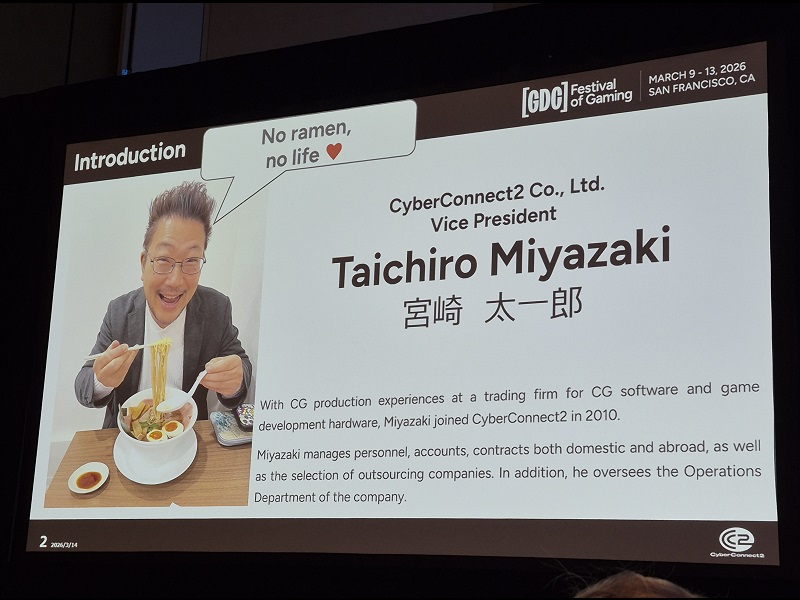
I do have a high interest in one day working for a Japanese company, better yet if I relocate to Japan. However I’m also a big fan of CyberConnect2 and their .hack// saga, and felt like I had to be there. I was not expecting the Vice President of the company to also be present, it was such a treat. They even opened the presentation with a showcase of all their latest releases, ending with the amazing .hack//Z.E.R.O., their upcoming game. No need to say I was fangirling all over the place.
The talk however was about getting hired in Japan, and although the talk itself was pretty fun, most points come across a bit on the generic side, but as it was also mentioned, if these points feel obvious to you, then thank the people around you for the good upbringing you had, as sadly most people don’t even do this minimum:
- Check the webpages of the companies you are interested in
- Be sure if Japanese is required or not. Knowing Japanese is always a plus
- +10 years of experience in the industry is what most companies are looking for
- Do your company research: know the job position and have an answer to the “why them?”
- Most big companies work with C++
- Know how to write game proposals
- Work on your soft team skills
- A big full portfolio is good in Japan, along with hard data, hours, software used, etc
- Add things to your portfolio that show that you understand other disciplines of the game development process
- It is ok to imitate something to show you are capable of creating, for the portfolio
- When in an interview you are asked about your taste in manga, anime or games, this is not just a random question, it is aimed at knowing how up-to-date the person is. If you can only name things that are old you might not really know how things work now.
I really like that last point, very useful for any interview. I always wondered if those kinds of questions were asked just to talk about simple stuff and relax the interviewee, but they do carry a lot of meaning if you see them through that lens.
Also, after the talk I went to Taichiro Miyazaki and personally thanked him for bringing the .hack// saga back, I had to do it. They just thanked me back, but alas, they did not give me any new information on the game.
Writing Games for a Distracted, Polarized, Media-Illiterate World - Alexa Ray Corriea from Gearbox and Adam Dolin as Independent
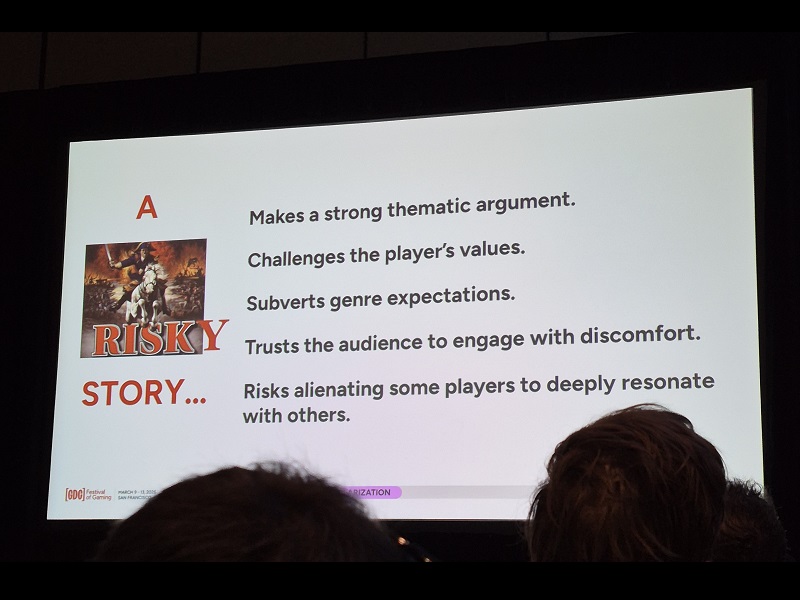
Alexa and Adam were incredible on stage, funny and witty, playing off each other. I would have stayed hours just listening to them talk about stuff. Their talk was also on point with current issues on how people are consuming media and reading in general. I would bet this whole thing would go unread. I still write it because I like to do it, and it is also in big part something I do for myself. Yet there is a sad big truth that people are reading less, and when they read they barely know how. On that note here are some of the tips they shared:
- When writing inside an indie studio consider the risk you are taking with the story
- What are your values and how do they compare with the company values?
- If you have strong thematic stands they won’t be liked by everyone
- When you get backlash / critiques on your work, ask questions and listen, but don’t get caught in the cesspool
- Create layered storytelling
- Reward curiosity
- Use strategic brevity: use short form texts so it is better ingested
- Media Literacy refers to the lack of an ability to have a critical analysis
- Trust your audience and write smart
All these talks throughout GDC have kindled back my drive to create, I do small and personal things in my spare time, like painting and writing. But being surrounded by so much creativity and amazing people does make me want to create something I can share with the world. Which is also an opportunity to put into practice everything I’ve learned these days.
GDC Encounters: Speed Networking Day 3
To close out GDC I decided to go to the last Networking day. This one felt pretty fast and I met a lot of other developers also looking for a job, some were artists, other composers, and a few programmers. Nowadays it’s getting hard to get a job, most companies are doing layoffs and AI is reducing job openings. Keep learning and trying is all we can do at the moment.
Bottom Line
Being here at GDC again has been a mix of feelings. On one hand I see myself back in a similar place 9 years ago, but instead of regressing I feel like this is a chance of starting a new chapter. A new stage in my career. And I’m planning on that. This year I plan to participate in as many global game events as money and time allows, while I keep looking for job opportunities that can take me to the next level.
This second visit to GDC, after 9 years, has left me standing with a positive drive to create and continue moving forward in an ever changing and arguably complicated industry. Still, I have taken the decision to start making my own videogame. It’s been a while since I’ve been thinking about a metroidvania game and it is about time I bring this idea into reality. There is a lot of work to do, as you may expect, so you won’t be seeing any news or special announcements any time soon. But from time to time I will update my blog when things start to take shape. I hope you are looking forward to that.
Comments